
Cohen–Lenstra heuristics for torsion in homology of random complexes
Type:
Papers
Publisher:
Experimental Mathematics
Submitted:
Jul 2019
Accepted:
Jul 2019
Publication date:
2018
Abstract:
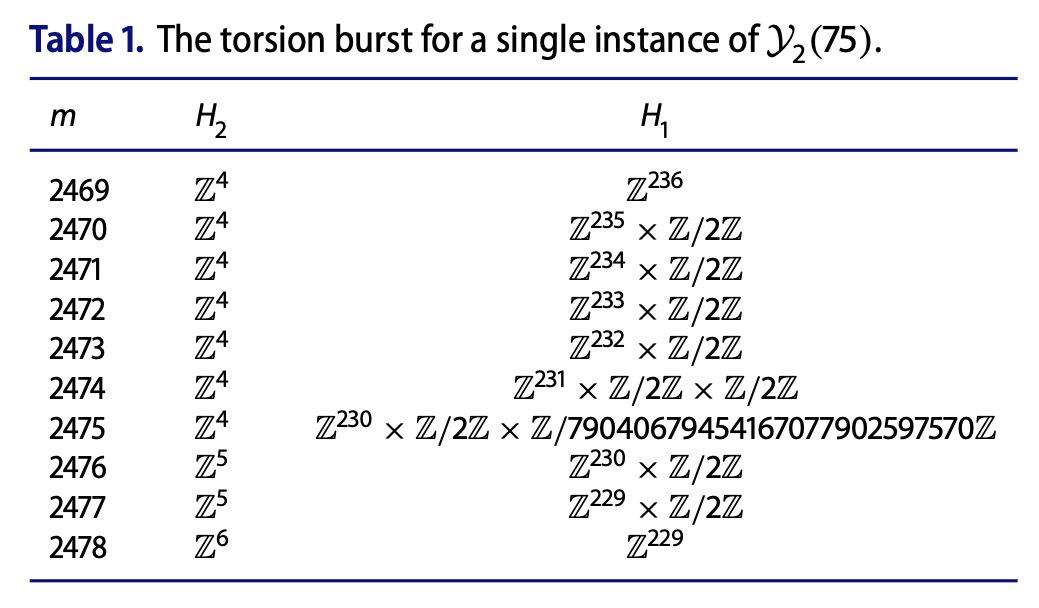
We study torsion in homology of the random $d$-complex $Y \sim Y_d(n,p)$ experimentally. Our experiments suggest that there is almost always a moment in the process where there is an enormous burst of torsion in homology $H_{d-1}(Y)$. This moment seems to coincide with the phase transition identified by Linial and Peled, where cycles in $H_d(Y)$ first appear with high probability.
Our main study is the limiting distribution on the $q$-part of the torsion subgroup of $H_{d-1}(Y)$ for small primes $q$. We find strong evidence for a limiting Cohen–Lenstra distribution, where the probability that the $q$-part is isomorphic to a given $q$-group $H$ is inversely proportional to the order of the automorphism group $|\mbox{Aut}(H)|$.
We also study the torsion in homology of the uniform random $\mathbb{Q}$-acyclic $2$-complex. This model is analogous to a uniform spanning tree on a complete graph, but more complicated topologically since Kalai showed that the expected order of the torsion group is exponentially large in $n^2$. We give experimental evidence that in this model also, the torsion is Cohen–Lenstra distributed in the limit.
External link: